How Perc Testing Supports Septic Engineering and Design in Wantage NJ
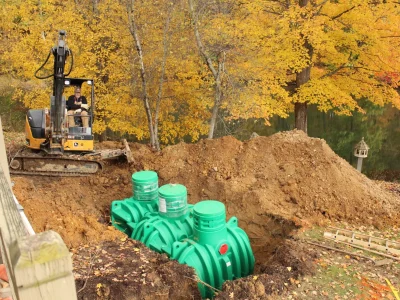

A septic system only works as well as the ground beneath it. That sounds simple, but in practice it is the starting point for almost every sound septic design decision made on a residential lot. Before tank size, disposal field layout, grading, pump selection, or reserve area planning, there is one basic question to answer: how does the soil handle water?
That is where perc testing comes in. In Wantage, NJ, perc testing is not a paperwork formality or a box to check before construction. It is one of the core tools used to understand whether a site can safely support onsite wastewater treatment, what kind of system is appropriate, and how that system should be engineered to perform over time. On some lots, test results confirm that a standard gravity system is realistic. On others, they reveal slow-moving soils, perched seasonal water, shallow restrictive layers, or slope limitations that change the design completely.
Anyone involved in septic engineering and design Wantage NJ needs to treat perc testing as part of a larger site evaluation, not as a standalone answer. The best outcomes come when testing is interpreted in context, with local topography, soil morphology, groundwater conditions, and home layout all considered together.
What a perc test really tells you
People often talk about a perc test as if it produces a simple pass or fail result. That is not how experienced septic designers look at it. A perc test measures how quickly water moves through soil under specific conditions. More importantly, it gives insight into the soil’s ability to absorb and transmit effluent in a controlled, long-term way.
A fast rate is not automatically ideal. If water moves through the ground too quickly, there may be concern about inadequate treatment before it reaches groundwater. If it moves too slowly, the disposal area may saturate, back up, or require a much larger footprint. The sweet spot depends on the soils present and the type of disposal field being considered.
On a practical level, perc testing helps answer several design questions at once. It supports the sizing of disposal fields. It influences whether a pressure-dosed system may be preferable to a conventional layout. It helps determine whether a raised or mounded solution may be necessary. It can also affect whether a property can support the desired house size, since bedroom count drives design flow.
That last point surprises many property owners. They may assume the home design comes first and the septic design follows. In reality, the lot often sets the upper limit. A beautiful set of plans for a four-bedroom home may need to be revised if the site conditions only support wastewater flows associated with fewer bedrooms, or if the lot requires a more specialized system with a larger disposal area.
Why Wantage properties need careful site evaluation
Wantage has the kind of landscape that makes broad assumptions risky. In one part of town, soils may be moderately well drained and workable for a conventional design. A short distance away, conditions can change sharply because of slope, rock fragments, seasonal high water table, or older disturbance from farming and grading.
That is common in Sussex County. Glacial history, rolling terrain, and varied parent materials create patchwork conditions. Two neighboring parcels can behave very differently in wet seasons. One lot may accept a trench field with relative ease. The next may have dense subsoil horizons or shallow limiting layers that call for a more engineered approach.
I have seen owners buy land based on road frontage, views, or clearing costs, only to learn later that the buildable envelope is far tighter than expected once septic setbacks, replacement area, and soil limitations are mapped out. The lot is not necessarily unusable, but the flexibility they thought they had disappears quickly. That is why perc testing, paired with test pits and full site review, should happen as early as possible.
In Wantage, timing matters too. A property that looks dry in late summer may tell a different story in spring. Site work should account for seasonal conditions rather than relying on appearances during one dry stretch of weather.
Perc testing is only one piece of the engineering picture
A competent septic design is never based on perc numbers alone. Perc testing works best when it is integrated with direct soil observation. Test pits reveal structure, mottling, depth to seasonal saturation indicators, rock content, and restrictive layers. Those field observations often explain why a perc result came in the way it did.
For example, a hole may show a moderate percolation rate near the surface, but deeper examination might reveal a dense fragipan-like layer or slowly permeable horizon below. Without that context, a designer could be misled into thinking the site has more long-term infiltration capacity than it really does. On the other hand, a somewhat slow perc rate may still be workable if the soil profile is otherwise favorable and the system can be sized appropriately.
This is the point where septic engineering becomes more than simple drafting. The engineer or designer has to interpret the data, weigh constraints, and choose a system that can be built, permitted, and maintained without chronic trouble.
A good design considers at least the following site realities:
- Soil absorption rate and consistency across the proposed field area
- Depth to seasonal high water table or restrictive layer
- Available horizontal area for both primary and reserve disposal zones
- Site grading, drainage patterns, and slope stability
- Setbacks from wells, property lines, structures, and environmental features
Those factors interact. A lot with decent perc rates can still be difficult if the only usable area lies too close to a well or steep break in grade. A smaller lot may technically support a system, but only if the house footprint, driveway alignment, and grading plan are coordinated early.
The relationship between perc rates and septic field sizing
One of the most direct ways perc testing influences design is through disposal field sizing. Slower soils generally require more infiltrative area. Faster soils may allow smaller areas, within regulatory and treatment limits. That does not mean the designer simply plugs a number into a chart and moves on. Field geometry, trench spacing, loading rate, reserve area, and installation conditions all matter.
Suppose two properties are both planned for homes with similar wastewater flows. Property A has moderately permeable soils and a broad, level disposal area. Property B has slower soils and a narrow usable corridor between setbacks. Property A may support a straightforward gravity design. Property B may need a more carefully distributed field, perhaps with pressure dosing to improve even loading, or even a different treatment approach depending on constraints.
This becomes especially important on custom home sites where the owner wants a specific floor plan, pool, detached garage, or long driveway. Every added improvement competes for space. Once the primary field and reserve area are laid out, the room left for everything else can shrink fast. Good septic engineering and design Wantage NJ often starts with protecting the best soil area on the lot before too many other site decisions get locked in.
What happens during a proper evaluation
Owners sometimes think of perc testing as a crew showing up for an hour, digging a few holes, and generating a result. The reality is usually more involved. The field investigation should look at the likely disposal area, not just one isolated point. On a large lot, that may mean comparing multiple potential field locations. On a difficult lot, it may mean ruling out several areas before finding the one that offers the best balance of separation, slope, and soil quality.
The process often unfolds in a logical sequence. First, the lot is reviewed for topography, access, and probable buildable zones. Test pits are then used to expose septic engineering and design Wantage NJ the soil profile and identify limiting conditions. Perc testing is performed in suitable locations under accepted procedures. The results are then paired with the intended design flow from the proposed residence or building use.
The design phase that follows is where experience shows. Numbers alone do not tell you how a field will be excavated on a sloped lot without smearing trench bottoms in wet weather. They do not tell you how winter installation challenges might affect soil handling, or whether runoff from an upslope driveway could overload the field area after heavy storms. A designer who has seen failed systems knows that preventing future hydraulic stress is just as important as satisfying the initial calculations.
Common edge cases in Wantage septic design
Many residential lots fit within a fairly standard design path. Others do not. Perc testing often reveals one of several edge conditions that force a more tailored approach.
Shallow depth to limiting layer is a common issue. If the soil suitable for treatment is not deep enough above groundwater or bedrock, a standard in-ground trench field may not provide the required separation. That can push the design toward a raised field or other alternative configuration.
Variable soils across the lot are another challenge. One side of a proposed yard may produce acceptable results while another side performs poorly. In those cases, the disposal field may need to be placed in a less intuitive location, which can affect house orientation, driveway layout, and drainage planning.
Steeper terrain also complicates matters. Even where perc rates are acceptable, slope can affect constructability and long-term stability. Effluent distribution needs to remain even. Surface water must be directed away from the field. Equipment access during installation has to be realistic. A site that looks fine on paper can become problematic if it requires excessive cut and fill around the septic area.
Then there is the issue of reserve area. Local approvals typically require not just a primary disposal area but room for a replacement area as well. On constrained lots, that reserve can be the factor that decides whether a design is feasible. Owners rarely think about replacement area until they are forced to, but it is a central part of responsible engineering.
Why early testing saves money
There is a strong temptation to postpone perc testing until architectural plans are complete or a land purchase is already underway. That can be expensive. Early site testing protects buyers and owners from making assumptions the land cannot support.
A few examples illustrate the point. A buyer may price a lot assuming a standard system, only to discover that site conditions require a more specialized design with higher installation cost. A homeowner may draw plans for a larger addition that pushes the home into a higher design flow category, then learn the existing or proposed field area cannot support that increase. A builder may position the house for curb appeal, only to find that the best soil area has been consumed by grading or hardscape.
None of those outcomes are rare. They happen when site constraints are treated as secondary. Perc testing does not eliminate all surprises, but it brings the biggest ones into view while changes are still affordable.
Reading beyond the number
An experienced designer pays attention not only to the reported percolation rate but also to how the test behaved. Did the holes show consistent infiltration or did rates vary noticeably between locations? Were there signs that the soil structure had been disturbed? Did the test area correspond with the most favorable horizon observed in the pits, or was there a mismatch?
Those details matter because septic systems operate for years, not for the duration of a single test. Effluent quality changes over time. Soil biomat develops at the infiltrative surface. Seasonal moisture conditions shift. A design that looks acceptable on a narrow reading of the perc result may be less resilient in the field than one developed with more conservative judgment.
That is one reason professional septic design tends to be cautious, especially on marginal lots. Conservative sizing, proper setbacks, and disciplined grading often look excessive to owners focused on first cost. Years later, those same decisions are usually what keep the system quiet and uneventful, which is exactly what you want from septic infrastructure.
How home design and septic design shape each other
On a strong lot, the house and septic system can be developed in parallel with minimal compromise. On a tighter lot, one shapes the other from the beginning. Bedroom count, fixture load, basement plans, garage placement, and future additions all influence wastewater design. At the same time, the septic field location can affect where the house should sit, how the driveway approaches it, and where drainage swales or retaining walls can go.
A practical designer will usually encourage owners to settle a few site planning questions early:
- Where is the best soil area for the primary and reserve field?
- How many bedrooms or what design flow is the property expected to support?
- What house placement protects the septic area from runoff and future disturbance?
- Is there enough room for wells, driveways, grading, and accessory features without conflict?
- Could future additions or land use changes create a problem later?
That sort of early coordination is where projects gain efficiency. It reduces redesigns, limits permit delays, and helps owners make informed trade-offs while options are still open.
The difference between passing a test and building a durable system
A site can technically pass perc testing and still be poorly suited to a bare-minimum design. This is one of the most important distinctions in the field. Passing means the site may meet basic criteria. Durability means the system has a reasonable margin for real-world use, seasonal moisture variation, and long-term maintenance.
I have seen systems on marginal sites operate well for septic engineering and design Wantage NJ years because they were conservatively designed, carefully installed, and protected from compaction. I have also seen systems on decent soils struggle because surface runoff was allowed to reach the field, heavy equipment disturbed the infiltration area, or owners built sheds and driveways too close to the reserve zone.
Engineering judgment fills the gap between what is allowed and what is wise. In Wantage, where properties can vary so sharply, that judgment matters more than any single test result.
Installation conditions matter as much as design calculations
It is worth saying plainly: good perc data can be undermined by poor installation. Soil that was suitable at the time of testing can be compacted by repeated machine traffic. Trench bottoms can be smeared if work is done in wet conditions. Imported fill can be mishandled. Grading can redirect water toward the field instead of away from it.
For that reason, septic engineering should carry through the entire project, not stop at plan preparation. Construction sequencing matters. Site protection matters. The best disposal area on the lot should be flagged and preserved early so it does not become a convenient staging area for materials or equipment.
This is especially important on custom builds where many trades are active at once. A septic field is not just another open patch of yard. It is treatment infrastructure with strict performance expectations. Respecting that during construction can be the difference between a system that starts strong and one that begins its life compromised.
What property owners should take from the process
For owners, perc testing can feel technical and opaque. But the practical message is straightforward. The test helps define what the land can support safely. When used properly, it protects health, groundwater, and investment value. It also gives clarity. Instead of guessing what kind of septic solution might work, owners get design direction grounded in field conditions.
In the context of septic engineering and design Wantage NJ, that clarity is valuable because local sites are rarely one-size-fits-all. A thoughtful evaluation can reveal opportunities as well as constraints. Sometimes a lot that first appears difficult turns out to have one excellent disposal area if the home is repositioned. Sometimes a larger home becomes possible because the best soil zone is preserved instead of fragmented by other improvements. Sometimes the smartest move is simply knowing early that expectations need to be adjusted.
That is the real role of perc testing in septic work. It supports decisions before they become expensive mistakes. It gives engineers and designers the field data they need to develop systems that fit the site rather than fight it. And on land where soils, slopes, and seasonal moisture can vary as much as they do in Wantage, that grounded approach is not optional. It is the basis of responsible design.
Excavating New Jersey LLC
406 County Road 565
Wantage, NJ 07461
(973) 791-4284
FAQ About septic engineering and design Wantage NJ
Who can design a septic system?
A New Jersey licensed professional engineer can assess the property and prepare the design. The local administrative authority can explain the applicable submission and permit requirements.
Why would I need an engineered septic system?
Soil conditions, groundwater, setbacks, lot size, or the expected wastewater flow can affect which designs are suitable. A site evaluation helps identify options for the property.
How much does it cost for an engineer to design a septic system in NJ?
Costs vary with site conditions, testing, surveying, and the scope of the design. Ask for an itemized quote that separates engineering, tests, permits, and installation.